|
Surreality Check A Savage Writer's Journal | |||||||||||||||||||||||||||||||||||||||||||||||||
Last Month (April)
02 May 2002
Why, indeed, does it matter? Didn't the Supreme Court just say that it is possible to contract around many aspects of copyright law in Tasini? Or is that what it meant?
The key to our little quandry is that the definition of work for hire ("WFH") is not a simple division of rights. That is what was at issue in Tasini: whether the author or the publisher retained certain rights when the contracts were silent. Instead, the WFH clause works to define who the author is—who has the ability to divide rights in the first place.
So, what happens if a contract calls something a WFH when it doesn't qualify as a WFH? By operation of law, the author is not the employer/commisioner/publisher/whoever is claiming hire status; it is the natural person(s) who actually produced the work. In other words, these natural persons have the revocation rights. Among others… the most important aspects of which return, again, to Tasini.
Many of the contracts purporting to make media tie-in works WFH did not include electronic rights in the grant of rights, for many of the same reasons as the pre-1994 contracts at issue in Tasini. So, just like those articles that were electronically reproduced without authorization in Tasini, reproducing these works electronically is an infringement of the authors' copyrights.
As serious as this problem may be, there is an even more dangerous issue lurking here.
| |||||||||||||||||||||||||||||||||||||||||||||||||
|
06 May 2002 The danger to publishers is in § 203 of the Copyright Act. Section 203 allows the natural person author or, if deceased, his surviving spouse, child(ren), or grandchild(ren) to revoke publication contracts 35 years after initial publication for a text work. The Act enhances this right by making it inalienable—that is, it cannot be contracted away, nor can it be later sold. So, then, what do publishers and packagers of tie-in works need to be afraid of? A WFH is not subject to revocation under § 203, as its author (for copyright purposes) is the hiring organization, not a natural person. (Whether an individual can be the "employer" for purposes of creating a WFH is a different issue, and not relevant here.) What about a work that is improperly classified as a WFH, but does not qualify? Ah. There's the rub. Section 203 should allow that work to go through the revocation process as directed by the person who actually wrote the thing, because authorship did not transfer. This is not at all the same thing as a so-called "all rights" contract, or even an explicit transfer of copyright. For purposes of § 203, those contracts are irrelevant. So, that means that… The Blish estate will, in the near future, have the right to revoke publication privileges for Spock Must Die!, no matter what the publication contract says. Following that, there will be many other properties shortly subject to the same conditions. Unfortunately, this does not apply to short fiction, unless that short fiction was originally published by itself in book form. (Look at the definition of WFH two entries previous.) Admittedly, most of these kinds of properties are not going to have much value 35 years after initial publication. However, the Star Drek and Star Warts properties will have at least some value. | |||||||||||||||||||||||||||||||||||||||||||||||||
|
09 May 2002 The courts appear to be uncovering validation for much that Al Q'aieda (and other fundamentalist groups, both Islamic and otherwise) use as excuses to hate the US government. Or, more accurately, that Terry Gilliam anticipated with the underappreciated masterpiece Brazil: Suspicion Breeds Confidence Recently, judges have done what they can to roll back some of the more-abusive tactics engaged in by the Justice Department, such as holding individuals as purported "witnesses" when they have no evidence not available in documents, but are immigrants from a "suspect group." What this really points out, more than anything else, is the value of life tenure for judges. (As an exercise for the student, you may wish to ponder the vastly higher reversal rates for criminal convictions in states which elect their judges, and try to figure out exactly what the Founders meant when they required the states to have a "republican form of government.") Sadly, it also only confirms the venality of our highest elected and cabinet-level officials. Rather than ask people who actually might know something about the societies in question—the academics and analysts who have spent their professional lives studying those societies—they jumped directly to the kind of tactics of which Stalin and the Tsars would have approved. Perhaps we should take Okhrana procedures off the reading list for senior Justice Department officials? This is not to excuse terrorism, by any means. But that means that terrorizing discernable segments of one's own population is equally reprehensible. Apparently, General Ashcroft and his minions have learned nothing from Manzanar, Hirabayashi, Korematsu, Gobitis, or Cohen. Even the pathetic production staff of Enterprise has invoked Manzanar (rather heavy-handedly, but at least they tried). Historically, every strong society has welcomed ideological and sociological diversity. Not necessarily agreed with it; but more than tolerated it. Keep in mind that Islam has nearly as many adherants as does Christianity, and perhaps more depending on definitions and exact methods of counting. Perhaps, though, given my own background, I shouldn't be surprised at this kind of essentially religious persecution. That is what it is, whatever excuses are given. There is no irony to me in defending the rights of individuals of Islamic heritage and belief to be themselves. (I draw the line at advocating killing others for being different.) I can have a Jewish heritage and despise bigotry of all kinds. Perhaps, in fact, those with Jewish heritages should be more condemning of bigotry. However, that takes confidence and trust that very few have mastered on the basis of history. Those who do not understand history are doomed to repeat it. I don't look forward to repeating the civil rights movement; it was too painful and difficult the first time. If this sounds like some namby-pamby liberal who would let the heathens overrun our God-fearing nation, keep in mind that—unlike virtually all of the policymakers now squawking about Arab immigrants—I have had my butt on the line "studying" that very difficulty. (Which is why there will be no entry on 11 May.) Once upon a time, we had a leader in this country who suggested that people should be judged by the contents of their characters, not the color of their skins. So, naturally enough, we killed him. We, because virtually nobody has really expressed interest in either searching beyond the obvious scapegoat (who may, or may not, have acted alone, but was certainly motivated by others). We, because on the basis of more incidents than I can shake a constitutional law hornbook at, we haven't learned a damned thing since then. | |||||||||||||||||||||||||||||||||||||||||||||||||
|
15 May 2002 It is the season (thanks to the artificial calendars of royalty reporting) during which actual sales become semipublic and thus cause semiannual panic in one portion of the publishing industry or another. Of late, there has been a great deal of gloom about the future of books sales. A number of respected crystal-ball-gazers in the industry have proclaimed, for about the twentieth time in the last quarter century, that the market for books is doomed. Hogwash. What may well be doomed is the traditional five-layered publishing model: author This is not necessarily a bad thing. The system has two-plus layers of commidification built in to a system that is dealing with something that is not a commodity. The distributor doesn't really care whether it is distributing books or widgets. Although there are some detailed distinctions between distributing widgets and distributing books (such as the discount/return mechanism), distributors really don't care too much what they are selling. Bookstores don't, either; some of the employees and managers as individuals do, but the store itself survives on the same basis as does the corner convenience store: turnover of rapidly changing stock. Most commercial publishers act very much as do the bookstores, particularly once one leaves the hallowed halls of the editorial department. That is at least one layer too many. The conceptual problem is that books are not interchangeable in the same way as, say, automobiles are. One doesn't go to the bookstore to buy a Viking mainstream novel with the optional gratuitous sex scenes and the hardback, as one might visit an automobile dealership to buy that Ford Mustang convertible with the candy-red paint job. However, automobile-industry approaches are beginning to dominate the mindset in publishing. At the same time, the objective quality of what is being published by the commercial publishers continues to deteriorate. In the mid-1970s, the Detroit automobile industry nearly collapsed of its own weight, because it produced shoddy merchandise that its customers began to believe did not meet their needs. At the same time, the Japanese automobile industry produceds better, more suitable merchandise at a better price. Absent a dubious bailout of Chrysler by the federal government, we'd be seeing only a competition between GM and Ford. It doesn't have to be that way in publishing. Although becoming a vertically integrated media conglomerate is extremely capital- and labor-intensive, become a small to mid-commercial press is not. It is not as easy as opening a corner liquor store, but still… So, what does that really mean? You don't think I've got some prescription for doing the thing I do worst (selling), do you? | |||||||||||||||||||||||||||||||||||||||||||||||||
|
21 May 2002 It sure as hell isn't a romantic interlude. I never was much of a fan of the Romantics, particularly not the sturm und drang school; with my social life, the other ordinary meaning is a joke. Eventually, I'm going to get back to the question of bookselling. The news out of DC during the last week has been very difficult to deal with. In the spirit of everyone else, I'm going to point some fingers, trying to keep the past as much the past as possible. The person in George III's government who bears the most responsibility for the 11 September atrocities is Condoleeza Rice. It is her job, as the National Security Advisor, to put together the disparate information gathered by the NSA, the CIA, the FBI, the DIA, the State Department, and open-source analysis to create a coherent picture. The problem was not the warnings of potential action; it is that those warnings were not in an appropriate context. However, Dr. Rice bears not much responsibility, even if she bears the most of any current administration figure. Keep in mind that she had had less than nine months to get her staff working, iron out administrative kinks, and come up to speed on what had been previously believed/known. Any attacks that happen now, however, will be much more firmly in her responsibility. But not completely. The single person who bears the most responsibility for the atrocities is Ronald Reagan. When he "stood up" to PATCO (although the union's demands were high, an objective look demonstrates that they were appropriate) and fired the air traffic controllers, then cut the FAA's budget in the name of "deregulation," he forced the one agency with the expertise and knowledge to enhance security at domestic airports to focus almost entirely on air traffic control and aircraft mishaps. The FAA just can't handle the rest of the issue. Compounding this are the intelligence failures caused by the "gadget buildup" of the 1980s at the expense of humint (human-source intelligence) and the aftereffects of Reagan's long-lost "war on drugs." (Didn't we learn anything from Prohibition the first time? Apparently not.) These factors combined to eliminate virtually all expertise among the FBI's leadership, and pretty much anywhere else in the agency, for counterintelligence not focused on either smuggling or the Cold War. Then there are all of the nonpublic reasons. Of course, no single person is to blame. But I really empathize with both the analysts whose warnings were ignored and the people who had to evaluate those warnings and prioritize them. I do not have anything like those atrocities on my conscience; I do, however, have enough to have some insight into what they're going through. This all brings back bad memories. ◊ ◊ ◊ I will try to write up a few notes at Baycon, but I do not expect to actually post anything more until next Tuesday. Unless, of course, there's some really juicy news. | |||||||||||||||||||||||||||||||||||||||||||||||||
|
24 May 2002 The trip to Baycon was relatively uneventful. (Yes, that is foreshadowing; I'm going to pay later.) I actually arrived almost 40 minutes early, checked in quickly, and met right up with the organizers and several others to do legalistic stuff. After that, we all trooped on down to the Meet the Guests party, at which Harlan told the famous story about the duck and the grapes. No, I'm not going to spoil it; you'll just have to go see him tell it. Following some meandering around with the charity casino and a long-overdue dinner (brontosaurusburger, I think it was; whatever it was, it was old and overcooked), it was time for the traditional Friday night event at any 'con: RHPS. This was run a bit differently from most, however; it was rather cabaret-style. Instead of a movie theater, we had tables and chairs (unfortunately, no scantily clad waitresses, but I suppose we can't have everything—even in California). Four of us associated with the RM took the back side of the table in the front center. This left four chairs around the front side, which were filled a little bit later by drunken Klingons. Barely Legal—an east-Bay group claiming to show the most skin in the Bay Area—acted as the "official" audience-participation troupe for the show. Prior to showing the film, they performed the usual quest for the inexperienced. Eventually, it turned out that there were three Rocky Horror virgins—a young man on crutches, a young man who might well have passed for Brad Majors, and a female Klingon. Thus, the three were requested to prove their worthiness with a fake orgasm. The Klingon girl (do they call young female Klingons "girls"?) gave a somewhat creditable rendition. The young man with the crutches, being somewhat more inventive, requested some inspiration, which was eagerly provided by Magenta, Columbia, and Janet; his, umm, performance was more convincing. The third young man actually did the best job: in a very flat voice, he just belted out "Do it to me, baby! Oh, that's good!" So, by the time the movie was over, it was 0230 Pacific time (0430 Central), and I was whipped. Well, no welts, but you get the idea. | |||||||||||||||||||||||||||||||||||||||||||||||||
|
25 May 2002 Saturday was the heaviest programming day at Baycon. (As an aside, all conventions should have program operations so well organized—with one exception that was beyond their control.) The culminating event for the day (for my programming) was the back-to-back Harlan-and-Jaws show and auction. The first half was our attempt to explain what Harlan's case really means. As you shall see, however, we were not entirely successful.
THE FOLLOWING DESCRIPTION HAS BEEN RATED NC–17 The Electronic Frontier Foundation is a valuable organization. However, it has a blind spot. More particularly, its leadership has a blind spot. Whether "information wants to be free" or not, entertainment is not information. Literature is not information. Like it or not, stealing copyrighted material is illegal. There is no First Amendment defense, either; as the Supreme Court has noted on several occasions, the First Amendment is an issue for core works (and fiction, however valuable to society, is not viewed as a core First Amendment area), and is covered by the "fair use" defense in § 107 of the Copyright Act. Wholesale copying of an entire work's exact expression never qualifies for "fair use" under even the most generous interpretation. However, certain leaders of the EFF—who, one might add, made their fortunes through exploitation of intellectual property, not through efficient placement of nut A on bolt B—can't be bothered to refer to either the facts or the law. Their minds are made up: Harlan is trying to destroy the Internet. The word "bullshit" was not in this particular individual's vocabulary. I spent the auction trying, in a relatively civil matter, to explain to him that he needed to read some pretty basic material before we would have anything to talk about. Despite five attempts to politely end the confrontation (believe me, he would have been no challenge, but I didn't want to stain the rug), security had to come and remove him. At least I kept him from disrupting the auction. While I was at a prearranged RM-oriented multibirthday dinner, things apparently boiled over some more. The one lawyer at EFF with whom I have actually discussed the matter, and who apparently has read the complaint, was (of course) not there, and things got rather testy rather quickly. I trust I need not go on. ◊ ◊ ◊ The partying later that evening was much more fun. And, of course, led to another Harlan legend— which I would cheerfully have helped with had I been in that part of the building. | |||||||||||||||||||||||||||||||||||||||||||||||||
|
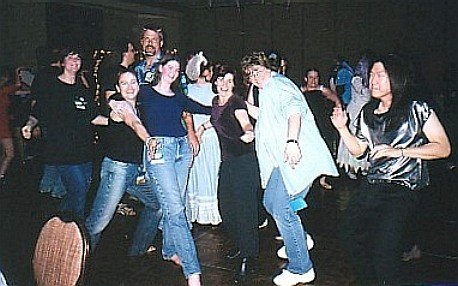
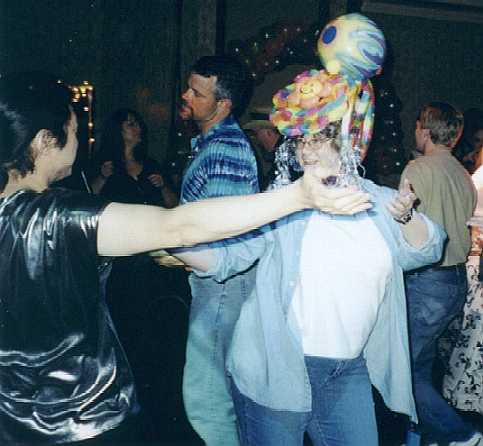
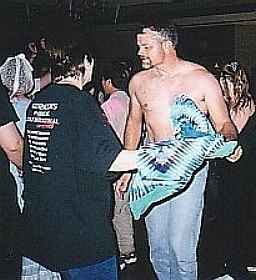
26 May 2002 In this day and age, we don't worry much about negatives. I have scans. Lots of scans. Here is a sampling of them.
| |||||||||||||||||||||||||||||||||||||||||||||||||
|
<<<Last Month (April) — Next Month (June)
|
|||||||||||||||||||||||||||||||||||||||||||||||||
|
Intellectual Property Rights: © 2002 John Savage. All rights reserved. You may contact me concerning permissions via email. This copyright notice overrides, negates, and renders void any alleged copyright or license claimed by any person or entity, specifically including but not limited to any claim of right or license by any web hosting service or software provider, except when I have transferred such rights with a signed writing that complies with the requirements for transferring the entire copyright as specified in Title 17 of the United States Code. This includes, but is not limited to, translation or other creation of derivative works, use in advertising or other publicity materials without prior authorization in writing, or any other non-private use that falls outside the fair use exception specified in Title 17 of the United States Code. If you have any question about whether commercial use, publicity or advertising use, or republication in any form satisfies this notice, it probably does not. Violations of intellectual property rights in these pages will be dealt with swiftly using appropriate process of law, probably including a note to your mother telling her that you're a thief. "The Savage Beast", "Savage Reviews", "Surreality Check", and the dragon-and-book banner are trade and service marks of the website owner. Other marks appearing on these pages belong to third parties, and appear either with permission or as exemplary references. |
|||||||||||||||||||||||||||||||||||||||||||||||||
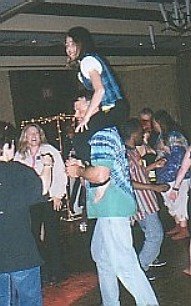
 Victoria can't wait to get Kent back upstairs