Surreality Check
A Savage Writer's Journal
| S | M | T | W | T | F | S |
|---|---|---|---|---|---|---|
| 27 | 28 | 29 | 30 | 1 | 2 | 3 |
| 4 | 5 | 6 | 7 | 8 | 9 | 10 |
| 11 | 12 | 13 | 14 | 15 | 16 | 17 |
| 18 | 19 | 20 | 21 | 22 | 23 | 24 |
| 25 | 26 | 27 | 28 | 29 | 30 | 31 |
| 23–26 May: BayCon (San Jose, CA) | ||||||
03 May 2003
Money Talks?
The McCain-Feingold bill that supposedly reformed campaign law did nothing of the kind. In fact, it entrenches the two-party system; and it's not very far from a two-party system to a one-party system. However, in many respects it was—and I say "was" for a reason—an improvement upon the status quo. Three judges took 1,625 pages to partially gut it yesterday.
The blame for this state of affairs goes back to the 1970s, to a case that has since been blown out of proportion—and was probably wrongly decided in the first place. Buckley v. Valeo, 424 U.S. 1 (1976) (yes, that Buckley) held that "money talks." 424 U.S. at 262 (White, J., concurring). Thus, restrictions on campaign expenditures were struck down. Restrictions on campaign contributions were modified, but those restrictions are ridiculously easy to evade.
A prime example of the evils that such a ruling promotes sits in the Mayor's office in New York City. This is not to say that Mr. Bloomberg is an evil man, or a bad mayor, or even inferior to his Democratic opponent. He used his personal fortune to outspend, outadvertise, and outmaneuver his opponent. I cannot agree with Justice White (and the Court since) that this is money "talking." It is money coercing. Sometimes a difference in degree can create a difference in kind.
The deafening roar of money (it has always been an influence, but seldom so naked nor so egregious) goes back to the demise of the "equal time" doctrine and Red Lion. In the 1960s and earlier, the FCC required stations to make "equal time" available for opposing viewpoints on political positions. The abuses that this could lead to were effectively satirized by Emily Litella (Gilda Radner's character on SNL). The equal time doctrine has a much more direct effect on speech than does advertising. When a broadcast station accepts a political ad, at least it is purportedly compensated for its choice to allow the candidate, party, or political action group to express its opinion on the airwaves. The equal time doctrine, however, forced the station to just place the broadcast on the air, giving the appearance that the station endorsed the views (regardless of the meaningless disclaimers). The Supreme Court has repeatedly upheld FCC regulations as regulating a "public good"—the airwaves—that is distinct from traditional print and public speaking. The equal time doctrine, however, went too far.
The saddest aspect of this whole mess was indirectly depicted in the first season of Fox's interesting dramatic experiment 24. In that season, a major subplot revolved around corruption among Senator Palmer's financial backers. That is not so surprising, or at least it shouldn't be after Watergate. What was surprising is that this subplot raised no eyebrows whatsoever: Corruption in campaign finance is assumed to be business as usual. That Fox is controlled by Rupert Murdoch, a man who has been known on occasion to use his media empire and fortune for inappropriate political advantage and the suppression of free speech, is a deliciously ironic cherry on this cake.
I'm still working my way through yesterday's monstrosity, which proves only that lawyers feel obligated to use fifty words wherever five would otherwise do. Since some of my work involves First Amendment issues, I'm essentially obligated to do so. There will definitely be Supreme Court review; the question is when. And by whom, as there remains a strong possibility of one or two retirements from the Court after this Term ends at the end of June. In any event, I am very unimpressed by the quality of writing and reasoning thus far; the Supreme Court would probably do well to ignore it, because adoption will undermine the Court's need to speak clearly on an issue inextricably intertwined with freedom of speech itself: freedom of association and its impact on elections.
05 May 2003
Puffery
As it turns out, I was right, and the Supreme Court of New York (Appellate Division) was wrong. The U.S. Supreme Court ruled today in Madigan v. Telemarketing Assocs., Inc.—unanimously—that actual, knowing misrepresentations in the context of collecting for charities are not protected from lawsuits asserting specific misrepresentations and fraud by the First Amendment. Most observers are looking at this case from the perspective of the still-pending decision in Nike v. Kasky; but it actually has a great deal of importance for the publishing and entertainment industries.
In mid-1999, the California Court of Appeals ruled that an objectively false statement on the cover of a book was advertising, and therefore subject to regulation under the same rules as any other advertising. Keimer v. Buena Vista Books, Inc., 75 Cal. App. 4th 1220 (1999) (the Beardstown Ladies book). The California court rejected a First Amendment defense that the cover was an integral part of the book, and therefore could not be subject to regulation for false advertising. Although today's Supreme Court opinion cites neither Keimer nor Lacoff v. Buena Vista Books, Inc.—the New York decision that, ironically enough, concerns the same book and same misrepresentations—the signal that it sends is fairly clear:
The First Amendment does not give commercial speakers
the right to lie without regulation for misrepresentation.
I doubt that very much of the publishing and entertainment industries will see that this requires a wholesale change. Not only does it deal with Sony (Columbia Pictures) and the problem of the phantom reviewer (more detailed description of context and a harsher version), but it goes a great deal farther. It clearly reaches the Beardstown Ladies problem, which concerned an objectively false statement used in an advertising capacity. (It also implies that Nike will be at most reversed for further factfinding, but that's beside the point here.) Telemarketing Associates also reaches a variety of other misconduct all too common in the publishing and entertainment businesses, usually excused as mere "puffery" and therefore not regulated as false advertising. In no particular order, these include:
- printing blurbs by endorsers who did not actually review the work, perhaps even including irrelevant statements regarding the purported skill of the author/band/director/whatever in outrageous instances
- culling selected positive soundbites from lukewarm or negative reviews
- incorrect and deceptive claims of authorship, such as Milli Vanilli, Virginia Andrews, and perhaps even some more traditional ghostwriting
- perhaps even misbranding by association, such as "Tom Clancy's Netforce" (which I have been led to believe involves virtually no input or direct management by Mr. Clancy), or "Isaac Asimov's Robot City" (all of which were produced after his death, if the Copyright Office's online records are correct)
To say that this has given me a very sharkly grin is an understatement.
10 May 2003
Corrupted Source Code
For those of you who've ended up here after reading Stephen's recent entry on fanfic, I'm going to both agree and disagree with Stephen. In a friendly sort of way.
We agree that budding writers who have aspirations of professional publication should not be wasting their time and energy on fan fiction. Stephen alludes to copyright problems, which do indeed exist. Worse are the trademark and unfair competition problems (see my forthcoming article in Speculations Issue 53, due out in less than a month). Bluntly, writing work that can never be published in an effort to improve one's fiction so as to achieve publication is self-defeating at best.
We also agree that writing fan fiction is not a good way to improve one's writing. First of all, the target is awfully damned low. There are a few—a very few—works of media fiction that have been published that also qualify as good fiction, even compared to the load of crap that passes for the fiction output of the publishing industry in general. More critically, though, fan fiction implicitly denies the necessity to integrate the elements of fiction into a whole. There are two reasons behind this failure. First, as Stephen notes, the authors don't own many of the elements in fan fiction. Ellison's original script for "The City on the Edge of Forever" (Star Trek original series) and its revision history are instructive. Roddenberry gutted much of the script because it didn't fit his vision of the series; as the owner of the series, that was within his power to do. The quality of the Ellison's original vision showed through nonetheless; that episode is widely considered the best of the original Star Trek episodes. Second, the low standards of fan fiction are inextricably intertwined with a low average literary sophistication of media fans (not necessarily ascribable to any individual fan). Bluntly, only trufen could even stomach some of the utterly abominable crap masquerading as "novels" in the major media fiction enterprises. Since that is being held up as something to aspire to … well, if you're still reading, you're smart enough to draw a reasonable conclusion.
Where we disagree, though, is in how to break students of the habit. Perhaps some of this is driven by the nature of the class. Stephen says that he simply prohibits fan fiction in the class. I'm afraid that's just as likely to be effective in breaking the addiction to fan fiction as is a high school's ban on smoking in the building on smokers. My approach would be somewhat different, and probably more subversive. It's based on something I did as a commanding officer.
One of the less-pleasant duties of the commanding officer is dealing with offenses committed by individuals in the unit. I assumed my first command just after a rash of DWIs (on and off base) in the squadron. Instead of yelling and screaming, I gave perpetrators a homework assignment. When I (or my First Sergeant) went to get the miscreant out of the stockade or city jail, the miscreant got a writing assignment, to be completed by 0730 the next day (whether or not a duty day) and submitted to me: he or she was to write for my signature, in accordance with the regulation guidance, the letter I would have had to send to his or her parents if he or she had managed to get seriously injured or killed while driving drunk. This method was quite successful in reducing the incidence of DWIs, whether because the airmen hated writing more than they liked drinking or because they were actually learning something and passing it on. And, unlike virtually all of the other units on the base, I never had a repeat offender.
Instead of a direct prohibition, I would require the student to write a research paper of between 2000 and 3000 words explicitly comparing certain published works of media fiction with certain parallel works in nonmedia fiction, to be submitted in addition to other course requirements, for no additional credit, before allowing the student to submit any fan fiction in the course. The subversion is simple: being forced to analyze the differences is the best way to help the student see for himself or herself that the target and method are inappropriate.
15 May 2003
An Authentic Stench of Madness
The real problems with warfare—aside from the death, dismemberment, destruction, and other inconveniences—only become apparent after the conflict is over. Among the survivors, that is. Some of them, at least.
It's sadly unsurprising that the most "pro-peace" of the major figures in the current administration is the only one with extensive combat experience—General Powell. Somebody along the way is going to blame Hollywood, et al., for making war seem so sanitized and neat. That's not a very good answer, though. There is plenty of other art in various forms out there to counter any "sanitization" (which is more a product of censorship than anything else anyway, a problem that bears considerable independent scrutiny). Shostakovich's symphonies 1943 and Babi Yar; Picasso's "Guernica"; Orwell's Homage to Catalonia; the list goes on.
The operative word in "cold war" is not "cold." Fortunately, I have no blood on my hands.
I always wore gloves.
16 May 2003
The Rule of Names
Returning to a theme that appears here all too frequently, why do so many writers whose work is speculative fiction reject that boundary, or try to redefine it so at least they won't be compared to Captain Kirk? Some of this hostility is no doubt driven by the reputation of science fiction and fantasy that has been built by marketing dorks and those who do not actually read for quality. Some of it, more disturbingly, is a literary racism: most readers, and particularly most lazy writers, do want to tell a book by its cover. That book with the rocket ship is colored. (Hell, we've even got a "colored books only" section in most bookstores!)
Most of the blame—and it is blame, because it is not a positive distinction—has to be laid at the feet of America's math teachers in the 1930s through 1960s, who uniformly did their very best to make mathematics difficult and thereby close the sciences to most of the school-age population. It is not entirely coincidental that so many of the early pioneers in both writing and fandom of science fiction had strong scientific and engineering backgrounds: the word "science" did not cause their eyes to glaze over. There is a similar problem with the word "fantasy," which is still a respectable term in music but was destroyed as a proper part of a "serious adult"'s psyche by some incredibly misguided disciples in the early and mid twentieth century who would probably be slaughtered en masse by their idols.
In any event, the right word is "speculative fiction." Not for the reasons that Margaret Atwood has proclaimed, because her explanation is nonsense (and that misunderstanding thoroughly undermines her latest novel, betraying a serious lack of study in either science fiction or utopian fiction). Instead, it is accurate for the reasons that Harlan Ellison proclaimed lo those many years ago.
[W]hen we get right down to the blood and bones, the beginning of speculative fiction was the first Cro-Magnon who imagined what it was out there snuffling around in the darkness just beyond his fire. If he envisioned it as having nine heads, bee-faceted eyes, fire-breathing jaws, sneakers and a tattersall vest, he was creating speculative fiction. If he saw it as a mountain lion, he was probably just au courant, and he doesn't count. Besides, he was chicken.
Harlan Ellison, Introduction: "Thirty-Two Soothsayers," Dangerous Visions (1967)
I'll vent my spleen on Atwood in the near future—primarily because she should know better, and there is the germ of something a great deal better if she'll just let her prejudice against colored books go.
19 May 2003
I Wouldn't Want My Sister Reading One
Do you feel a bit nervous when walking directly to the "colored books" section of the bookstore? (If not, you're probably working at a dot-com or have no shame.) And, more importantly, would you want your sister to bring a colored book home to show your parents?
Richard Powers's most recent novel—if you're not reading Powers and care at all about literature and the intersection between ideas, literature, and reality, you're not trying very hard—has a very subtle cover, in muted earthtones. That part of the subject of the book is the relationship among race, perceptions of race, and self-identification of race in America sheds some light on its own cover. The converse is also true. Similarly, the covers of Ursula K. Le Guin's last few books have been subtle, and somewhat muted. I think it no coincidence that those books do not come from "traditional" speculative fiction publishers. Le Guin is well know by the speculative fiction community; Powers writes some of the most interesting alternate history and "science in science fiction" books of the last quarter century, but is virtually ignored by trufen.
So, then, what does that say about the covers of the "colored books," aside from excoriating the poor collective taste and perceptiveness of art directors at the major speculative fiction publishers? Does it say the same thing as the shallowness of fin de siécle Paris, when both the whores and the "ladies of means" wore exceptionally bright clothing to hide their lack of personality and emotional attachment? (Does it even say that art directors are… never mind.) Perhaps a quick experiment will show what I mean. Compare the following two covers:
 |
 |
The first (left-hand) of these two covers is by far the most effective, for a very simple reason: it is subtle. The portrait is background, and although it provides a hint of "romance" it ambiguously invites the reader to discover what is really going on. The second cover tries too hard to play up the handsome knight, and looks like one of those awful Gabaldonish romances. Most damningly, the portrait shares the foreground with the textual material, thereby deemphasizing both. Queen of Camelot passes the ten-foot test; Grail Prince does not. (Not entirely coincidentally, the first of the two books is of higher quality, too.) The first cover is cheaper, too, especially if the marketing-dork language in the box at the bottom is removed—it's only a foil-on-two-color cover, while the second is a full four-color-process cover with lots of opportunities for poor trapping.
Of course, there is a legal issue lurking in here. Trust me. Given the recent discussions, I bet you can even spot it.
21 May 2003
A Failure of the Imagination
Leaving aside the legal issue for the moment, one of the other problems with contemporary cover design—not just in speculative fiction, but worse in speculative fiction and romance than elsewhere—is the extraordinary lack of imagination shown in the covers. That's not because art directors can't be imaginative; it's because the art directors have to get the covers past the marketing dorks for approval.

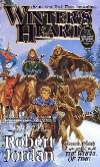 One of the peculiar problems with speculative fiction covers involves taking away the reader's imagination. Compare the two McKenzie covers above. The more-effective one, on the left, is also far less detailed. There is still a great deal left to the imagination about that character's personal appearance. The other is not so good, precisely because it is limiting in depicting a character who is otherwise described in the book only in words. The contrast is even greater across publishers, particularly when (in Mary Doria Russell's words) the agent or publisher isn't naive enough about speculative fiction to live down to the stereotypes. That the type on the right-hand alternative here is virtually unreadable is not due to its small size; it is simply badly designed, and actually falls into the background visually compared to the overdetailed stock fantasy figures that dominate the cover. On the other hand, the left-hand alternative here is from a non-category publisher (Knopf) that "doesn't know any better." It is both clearer and more attractive; further, it allows the reader more scope for his/her imagination.
Maybe what some of these cover designers are really trying to say is that readers of imaginative literature don't have very good imaginations. Or maybe…
to be continued
26 May 2003
Bitter on the Outside…
I learned some unexpected things at BayCon this weekend. And occasionally somewhat embarrassing, although perhaps moreso to the persons who discovered them.
- There really are pirate sluts in bondage. Or, at least, some people like them.
- Despite my preconceived notions, I am not bitter all the way to the core. I am bitter on the outside, but inside I've got creamy nougat. This is one of those "revelations" that may embarrass the "discoverer" more than it does me. Right, gorgeous? And clean those dirty little minds out. It's not like that. Well, not exactly (although the food amoeba dinner conversation involved was, well, see the previous item).
- Airport "security" is little more than a deterrent against the casual weirdo and pathetic lunatic than against a determined effort—or an intelligent schizophrenic.
- "Bistro meals"TM now make school cafeteria food look plentiful, nutritious, tasty, and fresh. If you're flying coach on That Airline, eat before you fly or be ready to starve.
- Nobody who specifies, designs, or builds airline seats has back trouble or even any relatives who do.
- Very few fen interested in military history understand the concept of a "force multiplier"—especially if they are writing their first/second/thirteenth cool military-oriented novel (science fiction or fantasy) with lots of swell battle scenes. Some of them are starting to understand a bit more about logistics, and may even have learned something positive about REMFs from a panel I moderated.
- Artists need to find some new subjects for the items they want to auction at art shows. Sorry, kids, but Star Wars isn't just old hat; it's older and moldier than the Hogwarts Sorting Hat. If I see one more "sensitive study" of Anakin Skywalker (at any age or stage of "development"), I think I'll burn it. I'll burn the whole damned art show down to the ground if I see half an aisle here and half and aisle there devoted to such frippery.
- Although I'm sure as hell not embarrassed by it, younger women who enter Masquerades or otherwise costume up at cons should do more than just cover a few strategic places with cloth, in case parts of their costumes slip. Especially if they're potentially jailbait.
Hmm. Looking at that list, maybe I should concentrate a little harder on finding the creamy nougat. On the other hand, I do have the negatives from three and a half rolls of film.
◊ ◊ ◊
[continued from 21 May] The plantation bosses seem to want to keep the color bar in place. That is, they don't want every book to have a reasonable chance to succeed in the marketplace. Or, at least, not every class of book.
Yes, we're back to ghetto literature and ghetto walls again. Keep in mind that the bosses of most publishers are not readers, or at least not avid readers. What they do read consists mostly of marketing reports, opinions of counsel, and Forbes (probably the same issues from which Hans Grüber learned so much about political prisoners). Since that's what they read, that presents the only opportunities for their subordinates to get attention to get promoted and stroke their egos. Rather like the problems faced by field bosses in the old South: instead of sustainable agriculture, they're spending their efforts on current cash crops like tobacco.
Although I'm not referring to any specific publishing-industry figure by intent, I am referring to a serious structural problem in the publishing industry. Too bad the Fourteenth Amendment doesn't apply to literature, and guarantee that all books shall receive the equal protection of the marketing department without discrimination on account of color. The industry needs to learn from Dr. Frank N. Furter that judging a book by its cover may have unforeseen consequences. Or else turn the marketing targets up three more points.
31 May 2003
Sigma Beta Alpha
The Chicago area is buzzing over a really bizarre hazing event that took place at a local high school. Apparently (at least according to the charges that have been filed), several parents provided beer to their 11th- and 12th-grade kids, resulting in something straight out of Revenge of the Nerds (at the very beginning, when the boys are still trying to join "normal" fraternities). Rather an extreme example of misguided parenting.
Of course, I've been through a hazing ritual myself: sitting on my butt for two days taking the bar exam, so that I could join Sigma Beta Alpha (State Bar Association). That hazing ritual is just as valid as is any fraternity rite of entry. IMNSHO, about one-third of the individuals holding law licenses in this nation should be permanently disbarred as incurably ethically challenged, and another third as incurably intellectually challenged. One need only look at the mathematics to see that the bar examination isn't doing its job as to the latter. The Illinois bar passage rate has been over 80%, and often near 90%, for the last quarter century. Assuming that everyone who fails the bar exam even once is incurably intellectually challenged—a clearly invalid assumption—the bar exam is keeping out less than half of those that it should. Several recent problems with the multistate bar exam—a multiple-choice test that forms about half of the bar exam score in most states—have resulted in persons who had previously been notified that they had passed the bar exam now "failing."
The bar exam should be completely eliminated. The public and the profession, not to mention individual applicants, would be much better served by requiring a realistic "character and fitness" evaluation, thus hopefully preventing at least some of that third of the bar that is incurably ethically challenged from ever becoming a member of the bar. It wouldn't hurt to have a required internship of six months, either. Most other professions do have some kind of internship requirement; law is almost unique in not requiring anything.
◊ ◊ ◊
Those of you interested in the goings on last weekend can try the thumbnail page. With captions. And I still have the negatives, plus a lot of photos that for various reasons (such as a roll of film that got seriously overexposed) didn't make it up here.
<<<Last Month (April) — Next Month (June)>>>
- the fine print first (you'll need to replace "{at}" with "@" on the address line). Please come back soon.
-
Return to

- Return to Surreality Check
Intellectual Property Rights: © 2003 John Savage. All rights reserved.
You may contact me concerning permissions via email.
This copyright notice overrides, negates, and renders void any alleged copyright or license claimed by any person or entity, specifically including but not limited to any claim of right or license by any web hosting service or software provider, except when I have transferred such rights with a signed writing that complies with the requirements for transferring the entire copyright as specified in Title 17 of the United States Code. This includes, but is not limited to, translation or other creation of derivative works, use in advertising or other publicity materials without prior authorization in writing, or any other non-private use that falls outside the fair use exception specified in Title 17 of the United States Code. If you have any question about whether commercial use, publicity or advertising use, or republication in any form satisfies this notice, it probably does not. Violations of intellectual property rights in these pages will be dealt with swiftly using appropriate process of law, probably including a note to your mother telling her that you're a thief.
"The Savage Beast", "Savage Reviews", "Surreality Check", and the dragon-and-book banner are trade and service marks of the website owner. Other marks appearing on these pages belong to third parties, and appear either with permission or as exemplary references.